

Abstract
In 2017, the Indian healthcare sector stood on the brink of a revolution: integrating the gut microbiome into standard patient care. This breakthrough promised to close critical diagnostic gaps by combining nutrition with pharmacology to transform disease treatment.
Nine years later, that promise remains unfulfilled. Despite a surge of VC-funded startups, gut microbiome testing has largely devolved into an FMCG-style pipeline designed to sell generic supplements and biotics, stripped of true scientific relevance.
Having developed and commercialized a scientifically validated cellular energetics platform, we possess the precise data points and insights needed to understand how the microbiome can be successfully integrated as a frontline diagnostic tool. Utilizing this robust database, we conducted a rigorous, deep-dive analysis of India’s leading microbiome companies. Our findings expose the systemic flaws and scientific gaps currently stalling the industry, while offering a definitive blueprint to correct how this powerful technology is commercialized.
- Microbiome DNA sequencing methodology-A flawed model to understand human microbial ecosystem
The human body operates on chemistry, not nomenclature.
Biological function is governed by biochemical reactions — driven by gene expression, protein activation, and metabolite secretion — not by the names of the microbes involved. These processes are deeply interconnected, involving microbe-to-microbe signaling as well as microbial interactions with human cells and mitochondria.
This is where current gut microbiome DNA testing falls critically short. These companies lack the technology and interpretive frameworks needed to measure what microbes are actually doing — the metabolites they are producing. Instead, they report on microbial identity, diversity, and theoretical capacity. None of this reveals actual biochemical function or the patterned bioelectric memory encoded within the microbiome.
Consider Faecalibacterium Prausnitzii as an illustration.
This bacterium is widely labeled a “butyrate producer.” A microbiome DNA test might tell you whether it is present, or assess its relative diversity — but it cannot tell you whether butyrate is actually being produced. The report may reference butyrate production as a potential to produce, while potential is not actual production.
In reality, F. prausnitzii draws on its bioelectric memory to selectively express genes, activate specific proteins, and drive butyrate synthesis. This entire functional cascade goes unmeasured and undecoded by DNA-based testing platforms.
The clinical consequence of this gap is significant. Butyrate is the primary fuel source for colonocytes and a key biochemical signal that instructs the immune system to remain in a non-inflammatory state. Crucially, colonocytes and immune cells have no awareness of which bacterium is present — they only respond to whether butyrate is actually available.
The bottom line:
Identifying which species are present generates information that is largely irrelevant to clinical outcomes. Without measuring what the microbiome is functionally producing, no meaningful or actionable intervention can follow.
2. High standard deviation in the results
The reliability of gut microbiome testing remains seriously questionable, with standard deviations exceeding 30% across results. When different testing companies analyze the same stool sample, they consistently produce conflicting microbiome profiles — often disagreeing on which organisms are even present. This is a fundamental flaw, given that bacterial composition should remain consistent across analyses of the same sample.
In many cases, these discrepancies stem from outdated bioinformatics practices, low-coverage pipelines, high rates of unclassified bacteria, and insufficient data generation — often under 2 GB — driven by cost-cutting rather than scientific rigor. As a result, what these tests reflect is the company’s own laboratory and bioinformatics methodology, not an accurate snapshot of the gut. The same individual’s sample can be labeled “healthy” by one company and “unhealthy” by another, exposing just how arbitrary these assessments can be.
The bottom line
These tests fail on two fronts simultaneously: they cannot capture the biochemical activity of the microbiome — including the metabolites it produces — and their standard methodologies cannot even reliably identify bacterial diversity and presence with basic precision. The recommendations that follow are therefore built on an unstable foundation, incapable of accounting for an individual’s unique biology.
3. No proprietary test, tech or algorithm
Most of these companies lack any proprietary testing or technology and instead rely on outsourced microbiome DNA tests — a handful operating on an OEM basis. These third-party tests are then dressed up in misleading marketing and inflated claims, such as being the “most advanced gut microbiome test,” with little to no scientific substantiation behind them.
For many of these players, the test itself is merely a front — a hook to sell pre-categorised supplements and biotics that are branded as “personalised,” when in reality, personalisation is largely absent.
A critical point worth underscoring: the nutrition recommendations generated from these tests are not truly personalised. They are built on shaky assumptions drawn from microbiome correlation studies conducted on general populations.
More on nutrition in next point
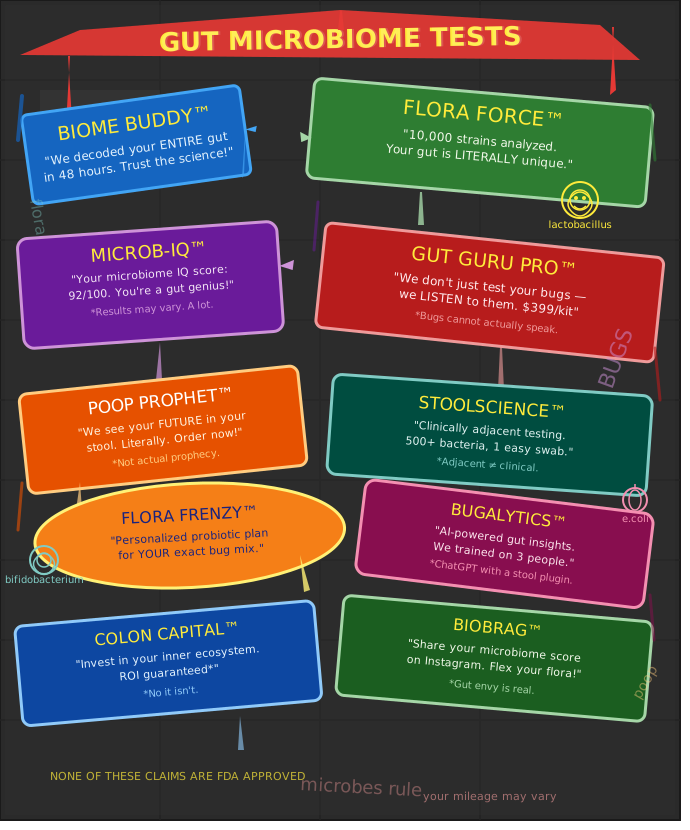
4. Nutrition recommendations are generic with no relevance to microbial metabolites
Gut microbiome DNA testing companies have a limited grasp of microbiome-nutrition interaction. Consequently, their recommendations tend to be generic — and worse, they are typically delivered all at once across multiple time periods, which raises a fundamental question: on what basis are these recommendations ever revised, when no longitudinal symptomatology data is being tracked?
Compounding this, the recommendations rarely specify dosages or dosing frequencies grounded in individual biology — making them anything but truly personalised.
In practice, meaningful nutrition recommendations should be driven by modulating and regulating metabolite secretion — something these companies don’t even measure.
Consider the complexity involved: nutritional ontology encompasses over 100,000 molecules. When you consume a particular food, you are ingesting thousands of molecules simultaneously. These molecules form a complex mixture, resulting in a flood of 25,000+ molecules entering the intestine — each interacting with active genes expressed by the microbiome. This cascade triggers the activation of specific proteins and drives the secretion of both pro-inflammatory and anti-inflammatory metabolites.
True personalised nutrition, therefore, should recommend specific foods with biologically grounded dosages and frequencies — calibrated to increase the production of beneficial metabolites while suppressing pro-inflammatory ones.
5. Probiotic supplements sold as subscription box is just a financial model with nothing which can be called personalized
Gut microbiome testing companies selling “personalised” probiotics claim their products are tailored to your unique gut ecosystem — identified through a DNA microbiome test. But there’s a fundamental flaw in that promise.
Current microbiome DNA tests can only identify bacterial species, not strains. Strain-level identification depends heavily on the bioinformatics pipeline used — and most of these companies, in an effort to cut costs, rely on basic or open-source pipelines that simply lack that resolution.
This matters enormously. Within a single species, different strains can produce entirely different metabolites with distinct — and sometimes opposite — effects on your physiology.
So the “personalisation” these companies sell is really just categorisation: segmenting customers into broad groups, then assigning strains based on generalised research or, in some cases, cost. That’s not your biology. That’s marketing.
Unfortunately, these companies are not equipped to answer these questions which have a direct implication of efficacy of selected probiotics.
→ How were the specific strains selected, and how was CFU dosage determined?
→ Have these strains, at these exact doses, been validated in clinical trials for my specific condition?
→ How do these strains survive stomach acid, bile, and digestive enzymes before reaching the gut?
→ How do they compete with established resident bacteria for nutrients?
→ What is the colonisation resistance risk — given that existing gut bacteria can produce LPS in response to new microbial entrants?
Perhaps the most overlooked flaw is this strain selection is rarely mapped against the broader microbial and host biology of the individual.
Take histamine metabolism as an example. Certain gut microbes express genes that drive histamine overproduction. Recommending species like Lactobacillus casei, L. bulgaricus, and L. reuteri — all known histamine producers — could backfire significantly, triggering an overactive immune response and symptoms such as bloating, constipation, anxiety, and brain fog.
Since these companies measure DNA, not metabolites, they have no visibility into actual histamine production levels. The result: their “personalised” recommendations could, in practice, be actively pro-inflammatory.
In fact, none of these companies have conducted clinical trials demonstrating the efficacy of their probiotics subscriptions
6. These companies work in isolation & lack focus on system biology
These companies are built on a narrative that gut microbiome drives systemic health — a claim rooted in correlation studies rather than causation. Their business practices, while commercially appealing, lack rigorous scientific grounding.
The gut microbiome undeniably plays a meaningful role in the onset of various systemic diseases. However, what truly matters isn’t the diversity of specific microbial species — it’s microbiome function: the metabolites produced, how those metabolites interact with neighboring microbes, host cells, and critically, the mitochondria within those cells.
This is precisely where gut microbiome DNA testing companies fall short. None of them can measure microbial metabolite secretion, cross-feeding dynamics, or the communication between oral and gut microbiomes — let alone the broader oral-gut-mitochondria axis. As a result, they capture less than 0.001% of your biological reality, and even that fragment is presented without meaningful context.
Consider this example.
It’s well established that gut microbial dysbiosis can drive digestive symptoms — bloating, chronic constipation, and conditions like IBD. But this is only part of the picture. In many cases, gut dysbiosis is itself a downstream consequence of what’s happening in the mouth. We swallow roughly one litre of saliva every day, continuously seeding our gut microbiome with oral bacteria. When oral dysbiosis allows specific pathogens to travel into the gut, it can trigger inflammation and contribute directly to IBD.
A company analyzing only your gut microbiome will miss this upstream cause entirely. Worse, it may recommend targeted probiotics to “rebalance” a gut that is already dysbiotic — without addressing the root trigger. Introducing probiotics into an already disturbed microbial ecosystem can further disrupt metabolic and neurological health, compounding the very problem it claimed to solve.
6. The marketing theatrics is pushing these companies into financial disaster
VC-funded gut microbiome DNA testing startups operate on a fundamentally flawed business model — one built around maximising transaction volume through scientifically dubious microbiome tests and off-the-shelf supplements, with little to no emphasis on genuine health outcomes or clinical relevance. Consequently, these companies channel 65–75% of their revenues into social media advertising, while investment in brand building and meaningful consumer education remains virtually nonexistent.
A deep-dive into the financials of these startups reveals three critical structural weaknesses:
- Revenue concentration in generic supplements: In 80–85% of gut microbiome DNA testing startups, roughly 90% of revenues are derived from supplements and probiotics — a finding that directly undermines their core claim of offering personalised probiotic solutions. Compounding this, the majority of these companies outsource both their microbiome testing and report generation, raising serious questions about their proprietary value proposition.
- Overdependence on pass-through testing: Among the remaining companies, approximately 55% of revenues come from tests, with the balance driven by probiotic supplement subscription boxes. Notably, these companies also outsource testing and report generation entirely — reducing their role to nothing more than intermediaries. This hollowed-out model raises profound doubts about their capacity to meaningfully serve individuals managing complex, multi-symptomatic conditions.
- Deeply negative unit economics: On average, these companies lose approximately 12.5% on every test at the variable cost level, even before accounting for fixed costs. On the supplements side, unit economics are similarly underwater, running at negative 10%. The cumulative effect is severe — with EBITDA losses exceeding 30%, pointing to a business model that is structurally unsustainable.
Given these deeply concerning financial practices, the long-term viability of these companies remains seriously in doubt.
Final words
Few frontiers in medicine carry the transformative potential of the gut microbiome — from reimagining diagnostics to redefining treatment. But that potential is only as strong as the science behind it. For the growing ecosystem of microbiome testing companies — from early-stage startups to established players — the path forward demands more than investor-driven growth. It requires building businesses where scientific credibility and economic sustainability reinforce each other, not compete.

Leave a Reply